Innovation
At ESPCI Paris - PSL, innovation is part of a continuum: education, research, and the transfer of knowledge to practical applications. This culture is rooted in interdisciplinarity (physics, chemistry, biology) and results in inventions, patents, partnerships, and the creation of new companies. On average, three startups are launched each year in high-tech fields. The incubator fosters the growth of deep-tech startups capable of addressing the major industrial, societal, and environmental challenges of the future in the fields of healthcare, biotech, greentech, and energy.

54
start-ups supported
2,500
jobs created
93%
five-year survival rate
€850M
raised
From Research to Impact: A Structured Path to Innovation
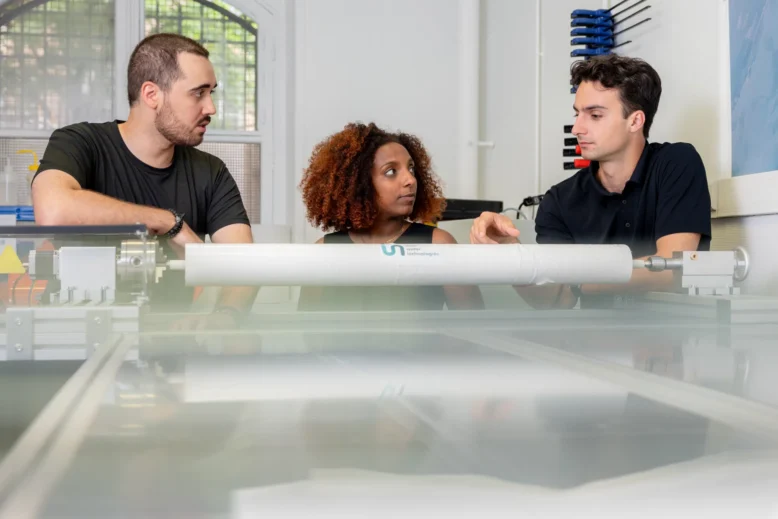
The school encourages dialogue between basic science and applied research. This approach is further supported by initiatives to promote the commercialization of research, including inventions, patents, licenses, and collaborations with the business community.
PC’UP: A Pivotal Deep-Tech Incubator
PC’UP is ESPCI’s deep tech incubator. It supports scientific projects with a strong technological focus (deep tech), from their inception through their development.
A few key figures illustrate the scale of this momentum: 54 startups supported, €850 million in funding raised, 128 patents and licenses, and more than 2,500 jobs created.
A three-step support process, tailored to the needs of each project
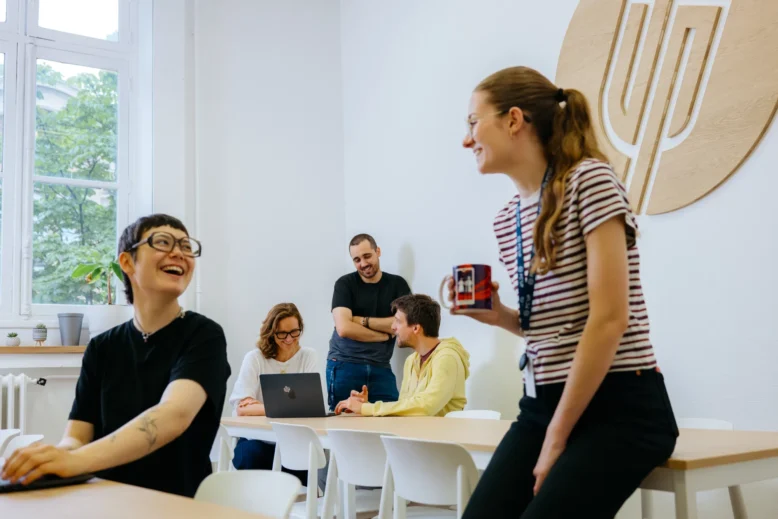
PC’UP offers three programs, tailored to the maturity level of the projects.
- START – Pre-incubation (6 months): supporting researchers who wish to develop a startup project, particularly those coming from ESPCI laboratories.
- BOOST – Incubation (2 years): Help a startup solidify its development plan, raise funds, overcome technological hurdles, and complete a proof of concept (POC) in a laboratory setting.
- SCALE – Acceleration (3 years): Supporting a startup that has validated a proof of concept (POC) and completed its first funding round as it moves toward the pre-industrialization and scaling-up phases.
Examples of spin-offs: start-ups originating from research
Spin-offs span a wide range of fields (healthcare, materials, quantum technology, AI, and bioengineering). The list of incubatees and alumni illustrates this diversity.
Non-exhaustive list of startups incubated at the school
An approach open to partners
The innovation ecosystem relies on a network of partners and public support, which ensure a solid foundation and accelerate the transition from research to business. In particular, PC’UP has been certified by the City of Paris and the Paris Region, and provides access to funding programs such as the Paris Innovation Fund and Innov’up Incubation.
This support is also part of a broader network, with partners and programs such as Paris Innovation, the Île-de-France Region, BPI France, France 2030, IPGG, and the PSL Innovation cluster.