 ESPCI web site







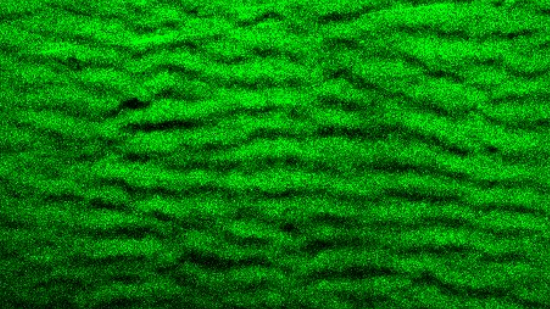 Microscopie confocale de fluoresence de la surface d'un élastomère après frottement, montrant la présence de rides d'usure et l'activation des mécanophores incorporés au réseau par rupture, révélant une accumulation locale de dommages moléculaires (en vert).
Every year, tire wear generates millions of tons of particles. Mostly invisible to the naked eye, they are released into the environment and represent a major industrial challenge. Better understanding how an elastomer wears is therefore not only a matter of material performance: it is also a societal issue.
How does an elastomer become damaged when it rubs? The answer is less straightforward than it may seem, because the first signs of damage form at a tiny scale and in an area that is difficult to observe. In this study published in Science Advances, researchers [1] show that, during so-called “mild” wear, the material does not initially degrade through crack propagation. Instead, it accumulates a multitude of diffuse damage beneath the surface, like a fabric that weakens thread by thread before fraying.
To track this nascent wear, the team developed model elastomers containing molecules capable of locally signaling the rupture of polymer chains. A rough glass contact is then rubbed repeatedly against the material, while the friction force and topography of the worn area are measured. Using three-dimensional mapping with confocal microscopy, the authors visualize for the first time the extent of molecular damage beneath the surface. This damage penetrates several micrometers deep, well beyond the visible abrasion zone alone.
The central finding is that this damage appears in bursts, during micro-slips at the level of the contacting asperities. Its extent therefore depends directly on the size of these surface irregularities. Above all, its accumulation is not linear: it grows slowly over the course of friction cycles. The authors interpret this as a probabilistic process: the most highly stretched polymer chains break first, then the next ones require more repeated stress to rupture.
The study also reveals an important trade-off. A molecular architecture that improves resistance to sudden rupture does not necessarily protect against repeated wear. Resisting a large crack is therefore not always enough to limit a multitude of small damage events. This result opens up avenues for designing more durable elastomers, particularly for applications where wear carries a high industrial and environmental cost, such as tires.
-
Reference
Ombeline Taisne et al., Wear in multiple network elastomers arises from the continuous accumulation of molecular damage rather than microcrack growth. Sci. Adv. 12, eaeb9858 (2026). DOI:10.1126/sciadv.aeb9858
-
Contact
Jean Comtet – Researcher, co-author of the study
Paul Turpault – ESPCI Paris - PSL Press: [communication@espci.fr](mailto:communication@espci.fr)
info portfolio
