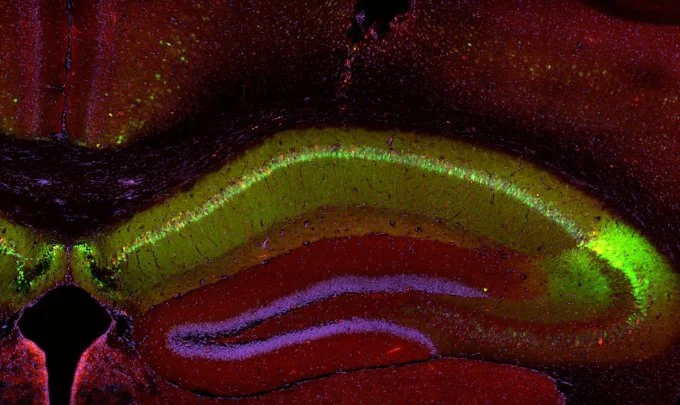
How memory is built brick by brick in the Hippocampus
Forming a memory is not simply a matter of passively “recording” a scene. The brain selects, sorts, and assembles different elements of the experience. In a recent study published in Nature Neuroscience, researchers [1] show that, when mice learn a fear memory, not all activated neurons play the same role. Only certain sets of neurons […]

Forming a memory is not simply a matter of passively “recording” a scene. The brain selects, sorts, and assembles different elements of the experience. In a recent study published in Nature Neuroscience, researchers [1] show that, when mice learn a fear memory, not all activated neurons play the same role. Only certain sets of neurons appear to form the core of the memory trace, known as the engram.
The researchers focused on the hippocampus, a key region involved in memory. Using a highly precise optogenetic tool capable of marking active neurons within very short time windows, they were able to distinguish several groups of cells recruited at different stages of learning: before the shock, during the shock, during episodes of fear-induced immobility (“freezing”), and outside of these episodes. This temporal precision changes the scale of observation: instead of considering all the neurons activated during the experiment, it allows the memory to be broken down into fine-grained sequences.
The main finding is clear. Artificially reactivating the neurons that were active during the shock or during the freezing response is sufficient to trigger a fear response in a different context. Conversely, reactivating the neurons mobilized before the shock, or outside of the freezing episode, does not trigger this recall. Better yet: inhibiting these same “shock” or “freezing” neurons subsequently disrupts the natural recall of the memory. In other words, not all cells involved during learning become memory cells. The brain appears to make a selection, as if it were retaining primarily the neurons associated with the most salient moments of the experience.
The researchers also show that these subsets are largely distinct from one another. And among them, the neurons active during freezing exhibit a unique property: when the memory is recalled, they reactivate in a more coordinated manner, as a true collective. This suggests that the engram is not merely a list of neurons, but a collective dynamic in which synchronization matters just as much as the identity of the cells.
This research refines our understanding of memory. A memory is not stored as a single block, but is constructed from neural components recruited at specific moments. This approach opens up new avenues for better understanding how an experience becomes a memory, and why, at times, certain memories take on excessive significance. The results were obtained in mice within a controlled experimental paradigm: they shed light on fundamental mechanisms, without yet implying any immediate clinical applications.
Notes
[1] de l’équipe Cerebral Codes and Circuits Connectivity du Laboratoire Plasticité du Cerveau l’ESPCI Paris – PSL / CNRS, en collaboration avec l’Université de Californie à Davis et le St. Jude Children’s Research Hospital (Memphis, États-Unis).
Image: Histological sections of the mouse hippocampus showing labeled neurons
References
Pouget, C., Morier, F., Autore, L. et al. Deconstruction of a memory engram reveals distinct ensembles recruited at learning. Nat Neurosci (2026).
https://doi.org/10.1038/s41593-026-02230-2
 Published on 09/03/2026
 Research
 Presse et communication scientifique : Paul Turpault, paul.turpault@espci.fr