Nicotine and Adolescence: A brain imbalance that predisposes to addiction

The mechanisms by which nicotine use during adolescence increases the risk of addiction in adulthood remain unclear. In a recent study published in Nature Communications, researchers [1] reveal that, in mice, exposure to nicotine during this critical period permanently disrupts developing dopaminergic circuits, thereby promoting a prolonged state of vulnerability.
Exposure to nicotine during adolescence has long been associated with an increased risk of nicotine dependence in adulthood. However, the precise mechanisms by which nicotine disrupts brain development and promotes this risk of dependence are still poorly understood. The study, published in the journal *Nature Communications*, sheds new light on this issue.
Adolescent mice exposed to nicotine exhibit prolonged vulnerability to nicotine
The researchers first observed that adolescent mice exhibited increased sensitivity to the rewarding effects of nicotine, both physiologically and behaviorally. The researchers then demonstrated that mice exposed to nicotine early in adolescence exhibited, once they reached adulthood, behaviors and physiological responses similar to those observed in young adolescent mice. In other words, exposure to nicotine during adolescence appeared to trap these animals in a prolonged state of vulnerability, characterized by increased sensitivity to the rewarding effects of nicotine and a reduced response to the anxiety-inducing effects of the substance.
This phenomenon is linked to a disruption of the circuits involved in reward processing
Researchers determined that this phenomenon was linked to a disruption in the circuits that synthesize dopamine, a key neurotransmitter involved in reward processing. More specifically, nicotine affects two groups of dopaminergic neurons differently depending on their projections: neurons projecting to the nucleus accumbens, a central brain region involved in reinforcement and motivation, were particularly affected in adolescent mice, as well as in adults who had consumed nicotine during adolescence. Conversely, neurons projecting to the amygdala, a region involved in the regulation of emotions and fear, did not show comparable disruptions.
These findings suggest that nicotine exposure during this critical developmental period causes a lasting imbalance in dopaminergic circuits, thereby keeping individuals in an immature brain state and making them more susceptible to developing addiction in adulthood. By restoring the balance of this dopaminergic neural activity, the researchers were able to restore normal behavior in adult mice that had been exposed to nicotine during adolescence, thereby demonstrating that targeted interventions aimed at restoring reward circuit activity can reduce acquired vulnerability to drugs.
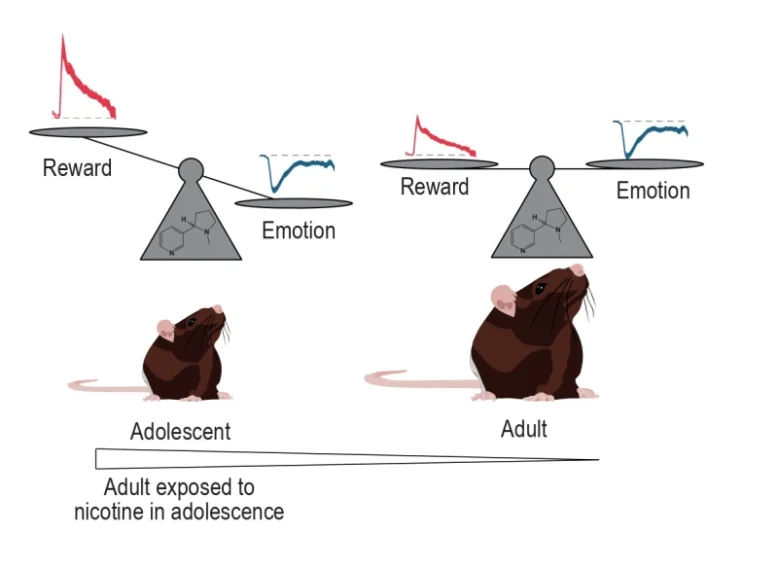
Adolescent mice show increased sensitivity to the rewarding effects of nicotine, while the negative emotional effects are less pronounced. Dopaminergic neurons projecting to the nucleus accumbens, a key region involved in the regulation of reward and motivation—exhibit an amplified response to nicotine in adolescents compared to adults. In contrast, neurons projecting to the amygdala (shown in blue), which are involved in the regulation of emotions and fear, do not undergo any notable changes. Exposure to nicotine during adolescence maintains this neuronal imbalance in adults, thereby prolonging their vulnerability to addiction.
Notes
[1] Des chercheurs du CNRS, de l’ESPCI Paris – PSL, de l’ICM, de l’Université Côte d’Azur et de Sorbonne Université
References
Transient nicotine exposure in early adolescent male mice freezes their dopamine circuits in an immature state
https://doi.org/10.1038/s41467-024-53327-w
Lauren M. Reynolds, Aylin Gulmez, Sophie L. Fayad, Renan Costa Campos, Daiana Rigoni, Claire Nguyen, Tinaïg Le Borgne, Thomas Topilko, Domitille Rajot, Clara Franco, Sebastian P. Fernandez, Fabio Marti, Nicolas Heck, Alexandre Mourot, Nicolas Renier, Jacques Barik, and Philippe Faure
 Published on 24/10/2024
 Research
 Philippe Faure +33 1 40 79 51 67/ +33 6 77 73 35 52 | phfaure@gmail.com Laboratoire Plasticité du Cerveau, ESPCI - CNRS UMR 8249