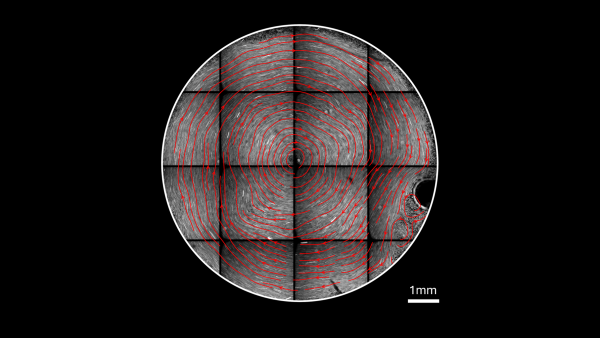
When Bacteria Create Giant Whirlpools

At first glance, on a microscopic scale, bacteria swim alone and unnoticed. But when millions of them gather in the same liquid, these invisible creatures are capable of spectacular behavior: they spontaneously organize themselves into currents, jets, and immense, shifting whirlpools.
Physicists refer to this as “bacterial turbulence.” It is a strange collective agitation that at times resembles the eddies of a river or the chaotic movements of the atmosphere. One question, however, has puzzled researchers for years: Do these giant structures have a natural size, determined by the bacteria themselves, or do they simply depend on the available space around them?
To understand this, researchers studied suspensions of Escherichia coli—a bacterium well known in the laboratory—in thin cylindrical chambers whose thickness varied greatly: from a few tens of micrometers to more than a millimeter. This is an important detail, since a single bacterium is only a few micrometers long. The scientists observed systems in which these tiny organisms could potentially generate collective movements a thousand times larger than themselves.
Of course, it’s impossible to track each individual bacterium in this bustling crowd. So the researchers used an elegant method: they dispersed tiny fluorescent beads into the liquid to serve as tracers. By filming their movement, they were able to reconstruct the invisible currents produced by the bacteria—much like how one might infer the movements of a river by observing leaves drifting on its surface.
The results are striking. The thicker the chamber, the more easily the bacteria begin to produce large-scale collective movements. And this relationship follows a remarkably simple rule: the density threshold required to trigger these large-scale flows is inversely proportional to the available thickness.
In other words, the size of the container is not a secondary factor. It directly determines the scale at which collective organization can emerge.
As the system approaches this threshold, the dynamics change profoundly: movements slow down while collective structures grow. The observed vortices do not converge toward a characteristic size. On the contrary, as the available space increases, these vortices can expand further—a behavior reminiscent of the phase transitions observed in thermodynamics near a critical point. In some experiments, transient vortices even end up spanning the entire width of the chamber, reaching up to one centimeter—nearly ten thousand times the size of a single bacterium.
This discovery suggests a fascinating idea: under these conditions, bacterial turbulence could be “scale-free.” There would be no hidden characteristic length dictated by the size of the microorganisms. It would be the very dimensions of the system that would determine the organization of the movements.
The phenomenon is based on hydrodynamic interactions: each bacterium sets the fluid in motion, influencing its neighbors, who in turn influence others. Through the fluid, thousands of organisms can thus coordinate their movements over distances that are enormous compared to their own scale.
These results also impose significant constraints on “active matter” models, a field of physics that studies systems capable of generating motion on their own—from bacterial colonies to certain bio-inspired materials.
However, not everything has been fully elucidated yet. The largest vortices remain transient, the walls of the device strongly influence the dynamics, and the exact role of random fluctuations in the orientation of the bacteria remains difficult to measure.
But one thing is already clear: even the tiniest organisms can, when working together, generate structures of spectacular scale. On their own scale, bacteria seem almost capable of creating their own microscopic weather, shaping currents that stir the surrounding liquid and disperse nutrients or dissolved oxygen—resources vital to the survival of the entire community.
Notes
This study brings together researchers from PMMH at ESPCI Paris – PSL, Sorbonne Université, Université Paris Cité and CNRS; the FAST Laboratory (Fluids, Automation and Thermal Systems), CNRS and Université Paris-Saclay; the School of Physics and Astronomy at the University of Edinburgh; and the Strathclyde Institute of Pharmacy and Biomedical Sciences at the University of Strathclyde.
References
B. Pérez-Estay, V. Martinez, C. Douarche, J. Schwarz-Linek, J. Arlt, P. Delville, G. McConnell, W. C. K. Poon, A. Lindner and E. Clement, “Collective motion in bacterial suspensions is scale-free,” Proceedings of the National Academy of Sciences of the United States of America, 123 (21), e2600266123 (2026).
https://doi.org/10.1073/pnas.2600266123
 Published on 03/06/2026
 Research
 PMMH
PMMH
 Anke Lindner, anke.lindner@espci.fr
 communication@espci.fr