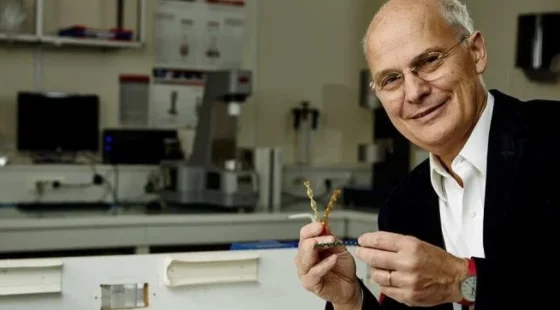
JF Joanny Honored by the Academy of Sciences

What if physics could revolutionize the study of cancer? The Ampère Prize is being awarded today to physicist Jean-François Joanny for his work on the functioning of biological cells and tissues. His work sheds new light on the subject, advancing knowledge in the field of biomedical research, with promising prospects for cancer treatment.
AT THE INTERSECTION OF PHYSICS AND BIOLOGY
Today, as part of the “Physical Approaches to Biological Problems” team—still at the Institut Curie—he proposes novel ways to describe cellular mechanisms in order to better understand them, applying his physicist’s eye and equations to the task.
He is exploring cellular biophysics by studying the filaments that make up the cell: like polymers, these filaments obey physical laws and provide the cell with a certain degree of elasticity. “Certain filaments, called microtubules, can be compared to rails along which proteins travel—true molecular motors that facilitate intracellular transport and generate mechanical forces within the cell,” explains Jean-François Joanny. For example, he describes how a cell splits in two during cytokinesis—a process that occurs during cell division—due to the contraction of an actin ring. What are the key applications of this approach? Developmental biology and cancer biology—fields in which cell division plays a pivotal role.
MOBILE PHONES LIKE SCHOOLS OF FISH
The study of the physical mechanisms of cell division naturally leads to research on the growth dynamics of tissues—and thus of tumors. For example, “the interfacial tension between healthy tissue and cancerous tissue has been defined by analogy with that between two fluids, and we have characterized the conditions that cause cancerous tissue to gain ground.” Another example: analyzing the ability of cells to move (motility) allows us to model how they move within an organism.
“ “It turns out that this collective behavior follows essentially the same laws as schools of fish or flocks of starlings,” the researcher notes.
From there, the model can be applied to the case of cancer cells that migrate and form metastases in host tissue. “But,” he is careful to point out, “we are not yet at the stage of developing new drugs; this is still basic research.”
BREAKING DOWN THE BARRIERS BETWEEN DISCIPLINES, AS AT ESPCI PARIS
“The Curie Institute is very open to dialogue with physicists; they understand what we can contribute to biology, and particularly to cancer biology,” explains Jean-François Joanny. According to him, the boundaries between physics, chemistry, and biology no longer apply today: “An interdisciplinary approach brings a fresh perspective to research that has sometimes stalled. This is exactly the kind of integrated model that has been in place at ESPCI Paris for the past twenty years.”
 Published on 21/11/2017
 Prize and distinctions