
A heart that floats in every direction

Is there a homogeneous object, other than a sphere, capable of floating in equilibrium regardless of its orientation? This question, known as Ulam’s floating-body problem, has inspired a great deal of mathematical research. These studies have shown that there are indeed shapes possessing this remarkable property. In two dimensions, a family of such shapes—Zindler curves—has been known since 1938, and more recent advances have also established the existence of such bodies in three dimensions.
But can such objects actually be made? That is the question Lucie Pontiggia, a student at ESPCI, set out to answer during her one-month introductory internship in the summer of 2025. Working alongside Angélique Campaniello, a doctoral student at the Langevin Institute, she built a heart-shaped float based on a Zindler curve and designed an experiment to study its behavior.
When its density is close to half that of the liquid, the core effectively remains in equilibrium regardless of its orientation: this is the first experimental demonstration of this property. The experiment also highlights the role of physical phenomena not included in the ideal model, such as surface tension.
Just a few months after Lucie’s internship, these results were featured in an article in the *American Journal of Physics* and made the cover of the journal.
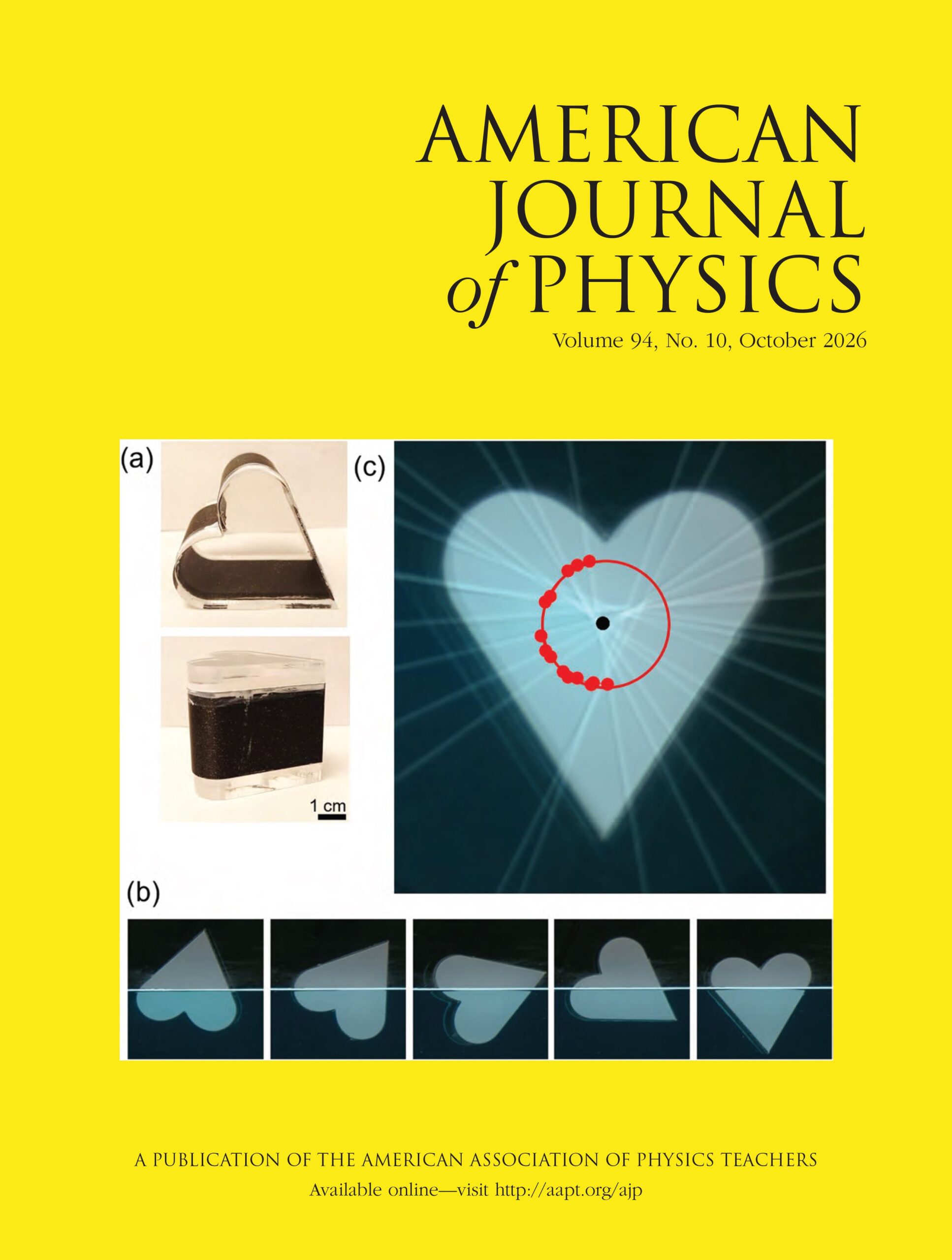
Beyond the scientific findings, the story behind this work is a particularly good illustration of the role of research-based education at ESPCI. Students begin engaging with research as early as their first year, notably through these short internships, which are supported by PSL University as part of the UROP program.
Students also participate in team-based science projects, during which they spend a year exploring original, open-ended questions by testing their ideas against empirical evidence. Several projects have led to scientific publications in leading journals and even to patent applications filed jointly with the students.
This floating heart thus serves as a fine illustration of the importance of research-based education and the value of incorporating it from the very beginning of the program.
References
A floating body with no preferred orientation : An experimental realization, Lucie Pontiggia, Angélique Campaniello et Emmanuel Fort, Am. J. Phys. 94, 853–858 (2026)
https://doi.org/10.1119/5.0336528
 Published on 06/10/2026
 Research
 Langevin Institute “Waves and Images”
 Emmanuel Fort, emmanuel.fort@espci.fr