Emmanuelle Gouillart: Three Priorities for an ESPCI at the Heart of Transitions
Consolidating scientific excellence, strengthening ties with industry, and opening up scientific career paths to a more diverse range of candidates: Emmanuelle Gouillart, Executive Director of ESPCI Paris – PSL since June 2026, outlines her priorities for the School. This ambition builds on the strength of the ESPCI model: combining basic research, research-based education, and innovation to contribute to environmental, technological, and societal transitions.

What role can an engineering school and a research center play in the face of the transformations taking place in our society? During her first press conference, Emmanuelle Gouillart outlined the vision for ESPCI Paris – PSL, placing the connections between science, education, and society at the heart of her plan.

ESPCI Paris is an exceptional place to invest in science, where today’s discoveries are paving the way for solutions to tomorrow’s major challenges.
Strengthening Excellence in Research and Education
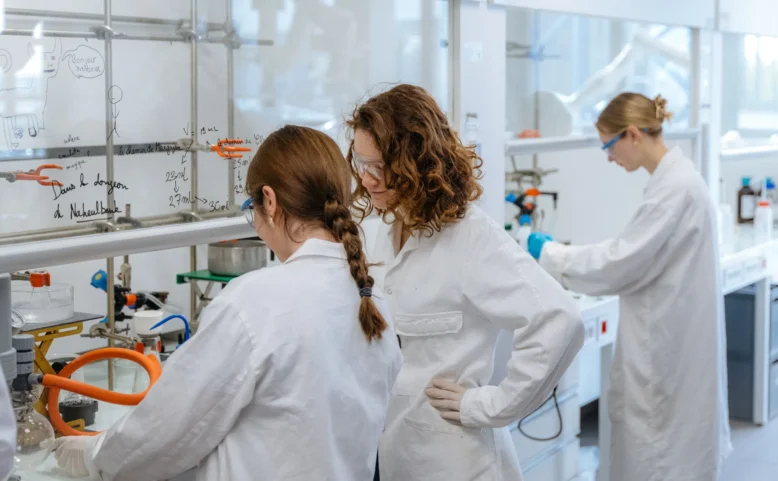
At the intersection of physics, chemistry, biology, and engineering, ESPCI’s laboratories advance knowledge in fields essential to societal transitions: materials, health, energy, and the environment. Preserving the conditions for this basic research and supporting it over the long term is a priority. This ambition is based on the constant interaction between research, education, and innovation, which sets the School apart.
ESPCI Paris offers a unique environment where fundamental research enriches engineering education and drives breakthrough innovations.
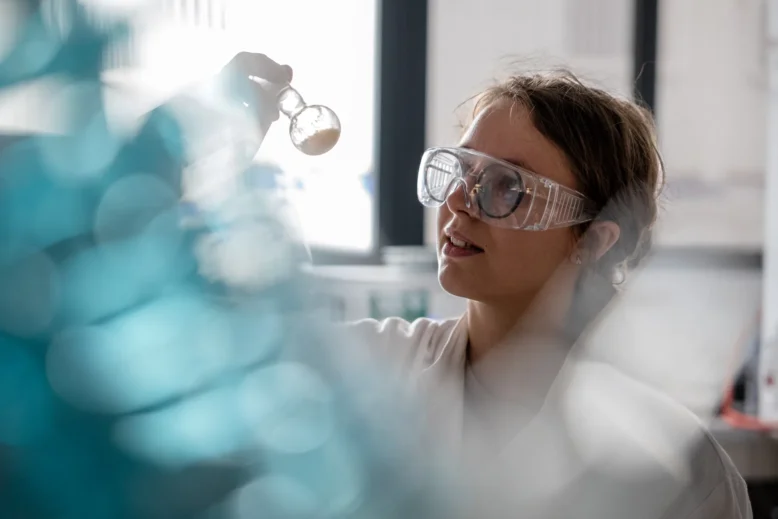
In light of the rise of artificial intelligence and the accelerating pace of technological change, learning through research takes on its full significance. Experimenting, measuring, analyzing results, and understanding the limitations of the tools used help students develop independent thinking and the ability to tackle new problems.
ESPCI aims to enable more people to benefit from its research-based education model. The 2026 academic year will welcome 93 new engineering students, 14 students in the ACTION Master’s program, and 51 students in the ST4Health Master’s program. The launch of continuing education modules will also enable professionals to continue their education throughout their careers. At the same time, the creation of a sustainable development department reinforces the integration of the ecological transition into the School’s educational programs and operations.
Strengthen relationships with the industry
Engagement with businesses provides fertile ground for identifying new scientific questions, developing research collaborations, and facilitating the transition from discoveries to their practical applications. Emmanuelle Gouillart hopes to strengthen these relationships. The PC’UP incubator and the PC Tech project are part of this effort, bringing together laboratories, startups, and major corporations within the PSL University ecosystem.
These collaborations also enrich the educational experience. They help companies better understand the skills of the engineers and PhD graduates trained at ESPCI: expertise in experimentation, a multidisciplinary approach, and the ability to explore complex problems.
Opening up scientific career paths to a more diverse range of candidates
Enabling everyone to envision a career in science, regardless of gender or social background, is another priority of the project. This outreach begins at a very young age. School outreach programs, the Science Festival, and a science camp for high school girls: these are all opportunities to discover research, meet scientists, and broaden horizons. These initiatives are specifically designed to encourage more young women to pursue careers in science. Today, they account for between 30 and 40 percent of engineering students, depending on the graduating class.
Making these programs more accessible also means removing financial barriers. One-third of ESPCI students receive a Joliot scholarship, which doubles the amount of their CROUS grant and allows them to continue their studies under better conditions.
A campus to support these ambitions
The transformation of the Vauquelin site in the heart of the 5th arrondissement is part of this project for the School. The second phase of construction, scheduled for completion in 2028, includes new lecture halls and classrooms, a library, spaces dedicated to student life, and more than 4,000 m² of green spaces. These new facilities are designed to meet the needs of research, education, and community life for decades to come. They also support the goal of strengthening ESPCI’s ties with the city and its surrounding area, in partnership with the City of Paris and PSL University.
I would like ESPCI Paris to be more widely recognized as a place where science is part of the city’s life. We have a responsibility to share the work being done here, create opportunities for people to connect, and show how research can help address the challenges we face in our everyday lives.
 Published on 22/10/2026
 School life