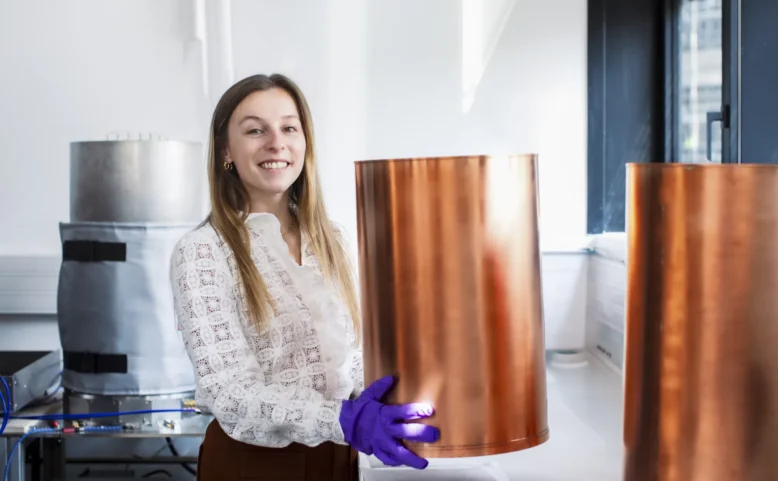
Chloé Fruy, an ESPCI alumna, winner of the 2026 L’Oréal-UNESCO Young Talents France Award
Chloé Fruy, a doctoral student in quantum physics at the École normale supérieure Physics Laboratory (LPENS), is one of 35 young female researchers honored this year with the L’Oréal-UNESCO France Young Talents Award for Women in Science. This marks a new milestone in the career of this young physicist, a graduate of ESPCI Paris – PSL, who is currently focusing her research on the detection of dark matter.

A native of Cobrieux, in the Nord department, Chloé Fruy gravitated toward the sciences at a very early age. After completing a preparatory program in Lille, she enrolled at Chimie ParisTech – PSL and then continued part of her studies at ESPCI as a member of the Class of 139, where she specialized in quantum physics.
Her career path then took her to several laboratories in France and abroad. From the Paris Observatory to Uppsala University in Sweden, via IBM Research in the United States and the Sherbrooke Quantum Institute in Canada, her internships allowed her to discover different facets of experimental research and gradually refine her interest in quantum technologies.
Quantum detectors to track down dark matter
Chloé Fruy then completed her doctoral dissertation at the Laboratory of Physics and Materials Science (LPEM) and the Physics Laboratory of the École normale supérieure (LPENS), as part of the Hybrid Quantum Circuits team, under the supervision of Takis Kontos. Her research, for which she is now being honored, focused on the development of dark matter detectors based on quantum sensors.
She has taken a particular interest in axions, hypothetical particles that are not part of the Standard Model of particle physics and are among the candidates proposed to explain dark matter. Their mass remains unknown, but experimental research is exploring, in particular, the microwave frequency range. If they exist, axions should interact very weakly with the electromagnetic field, introducing a minuscule change to Maxwell’s equations.
To detect such a faint signal, Chloé Fruy worked on developing an innovative cryogenic detector that combines magnetic-field-resistant granular superconducting circuits, a microwave cavity, and magnetic materials. This architecture is based on an interface known as a “tripartite quantum magnonic” interface, which allows for the coupling of multiple quantum systems.
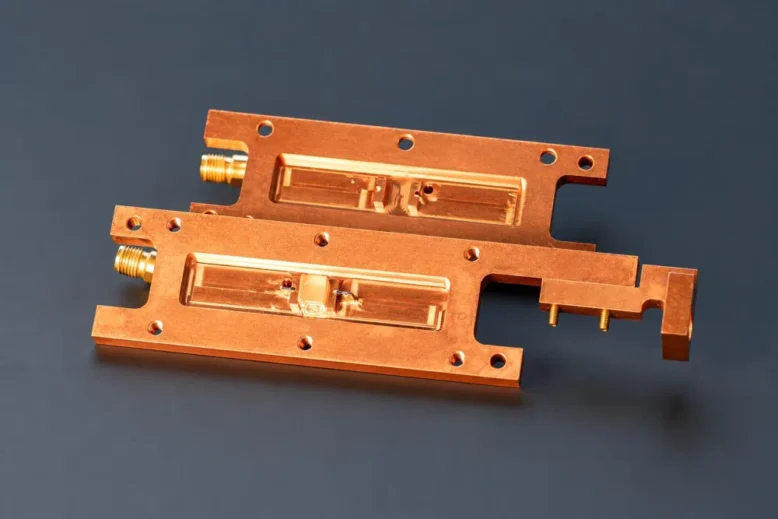
This approach could significantly expand the range of masses detectable by current axion detectors, known as haloscopes, particularly toward higher masses. It thus opens up new possibilities for experimentally testing the hypothesis that the axion is a component of dark matter.
Dark matter, which is invisible and does not emit light, has never been directly observed, although its gravitational effects suggest that it accounts for a significant portion of the matter in the universe. Detecting the axion one day would therefore represent a major breakthrough in our understanding of the universe’s composition.
The L’Oréal-UNESCO Young Talents France Award
Established in 2007, the L’Oréal-UNESCO Young Talents France Award “For Women in Science” annually honors 35 doctoral and postdoctoral researchers for the quality of their research and their scientific potential. Sponsored by the L’Oréal Foundation, in partnership with the French Academy of Sciences and the French National Commission for UNESCO, the program also aims to support young female researchers at a critical stage in their careers and to increase their visibility in disciplines where women remain underrepresented.
The issue of women’s representation in science has played a significant role in Chloé Fruy’s career. From the very beginning of her dissertation, she has been committed to improving women’s representation in research. In particular, she highlights the influence that certain stereotypes can still have on academic choices: in high school, a teacher advised her to choose a preparatory class in chemistry rather than mathematics on the grounds that “girls prefer chemistry.”
For the young researcher, acknowledging the existence of these biases is a necessary step toward changing attitudes and enabling young girls to envision themselves in scientific careers.
An award that has been given to several recipients with ties to ESPCI
Chloé Fruy joins several female researchers and ESPCI alumni who have already been recognized by the L’Oréal-UNESCO For Women in Science program.
In 2024, Aliénor Rivière, a researcher at the Physics and Mechanics of Heterogeneous Media (PMMH) laboratory, and Paula A. Gomes, a researcher at the Soft Matter Science and Engineering (SIMM) laboratory, were both awarded the Young Talents France Prize.
In 2022, the award was presented to Irène Nagle, an engineer and graduate of ESPCI, and Noémi Renaudin, who had completed her thesis at the Physics for Medicine Paris laboratory. A year earlier, Judith Pineau, also a graduate of the School, and Lauren Reynolds, then a postdoctoral fellow at the Brain Plasticity Laboratory, were among the 2021 winners.
This is nothing new for the School: as early as 2015, ESPCI engineering students Marine Bézagu and Laura Magro had also been recognized by the program.
ESPCI extends its warmest congratulations to Chloé Fruy on this honor and on her continued scientific career.
 Published on 03/10/2026
 Prize and distinctions