[1] de l’Institut Langevin ESPCI/CNRS et de l’institut de Physique du Globe de Paris
A breathtaking view into the depths of a volcano

Scientists [1] have developed a highly innovative imaging method capable of probing the depths of a volcano with a resolution and depth unmatched to date. Published in the journal Communications, Earth & Environment, this research offers a unique and promising new observational method for volcanology and eruption prediction.
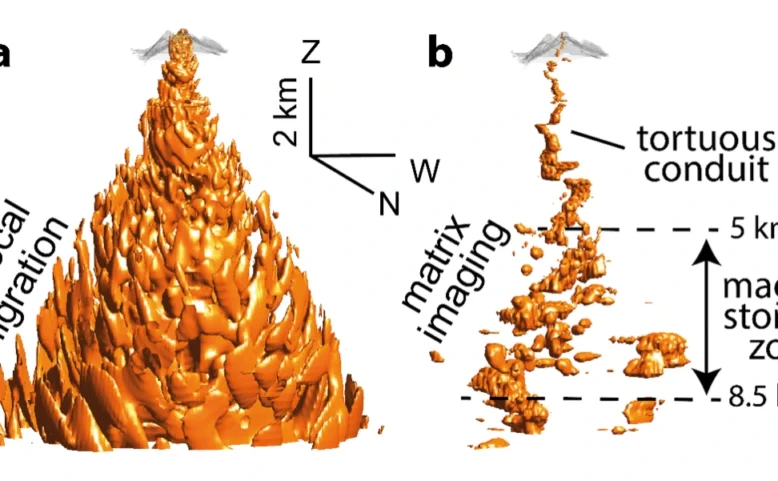
Volcanoes consist of a complex arrangement of fractured rocks and pockets of liquid and gas that are so heterogeneous that imaging them is particularly difficult. Seismic tomography uses earthquakes to probe their mechanical properties, but it requires significant seismic activity, and the resolution of the resulting images is only on the order of a few kilometers. Researchers at the Langevin Institute and the Paris Institute of Earth Physics have developed a new imaging method, known as passive matrix imaging, which delves into the volcano’s depths to a depth of up to ten kilometers and maps its internal structure with an accuracy of about one hundred meters using only seismic noise. These results were obtained from the La Soufrière volcano in Guadeloupe. They reveal the tortuous shape of the volcano’s vent in its upper section. Most importantly, they confirm the existence of a large, deep magma reservoir and its organization into a network of interconnected horizontal magma lenses. In addition to confirming certain conceptual models proposed in the literature, such images offer a unique perspective on volcanoes, one that has the potential to revolutionize the field of volcanology.
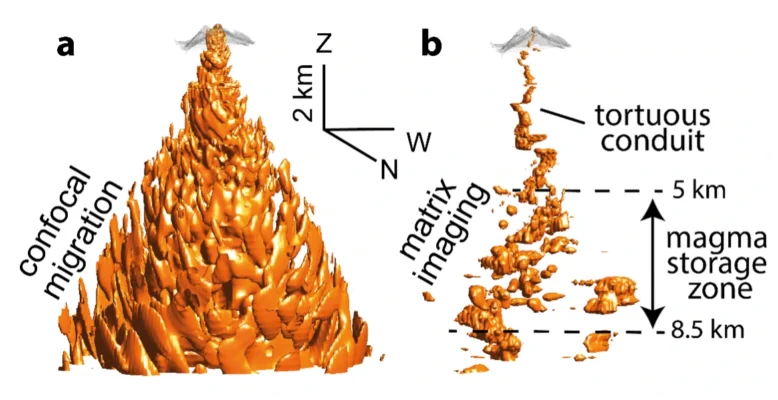
To achieve this, the scientists, in collaboration with the Guadeloupe Volcanological and Seismological Observatory, deployed a sparse network of geophones that detect not only strong earthquake tremors but also seismic noise induced by wind, the ocean, and human activity. This seismic noise, measured over a two-month period, was used to construct a reflection matrix, inspired by previous work by the same team on ultrasonic imaging and optical microscopy recently published in Nature Communications. This matrix is used to finely compensate for the distortions that seismic waves undergo as they pass through the volcano’s various geological structures and magma chambers. These inhomogeneities are thus no longer an obstacle, and an image of the volcano’s internal structure is obtained as if the volcano had become transparent.
This passive array imaging technique can be applied to any volcano, provided that a dense network of geophones is deployed there. It thus opens up a wide range of applications in volcanology, enabling a better understanding of the internal structure of volcanoes and magma movements at depth, thereby allowing for more effective prediction of volcanic eruptions. This research was supported by an ERC Consolidator Grant (No. 819261) under the European Union’s Horizon 2020 research and innovation program.
Bibliography
: “Matrix Imaging as a Tool for High-Resolution Monitoring of Deep Volcanic Plumbing Systems with Seismic Noise.” Elsa Giraudat, Arnaud Burtin, Arthur Le Ber, Mathias Fink, Jean-Christophe Komorowski, and Alexandre Aubry. Communications, Earth & Environment, September XX, 2024. https://doi.org/10.1038/s43247-024-01659-2
Notes
Key information
 Published on 17/09/2024
 Research
 Alexandre Aubry, Directeur de recherche CNRS à l’Institut Langevin (CNRS/ESPCI Paris – PSL) | +33 1 80 96 30 66 / +33 6 49 52 64 13 | alexandre.aubry@espci.fr Arnaud Burtin, Physicien à l’Institut de Physique du Globe de Paris (Université Paris Cité/CNRS) | +33 1 83 95 75 49 | burtin@ipgp.fr