A new morphogenesis

Morphogenesis, the study of how patterns emerge in homogeneous systems, has long intrigued scientists. Models such as Turing’s have shown how regular patterns can emerge through chemical reactions. But a new study, published in PNAS, sheds light on an entirely new mechanism.
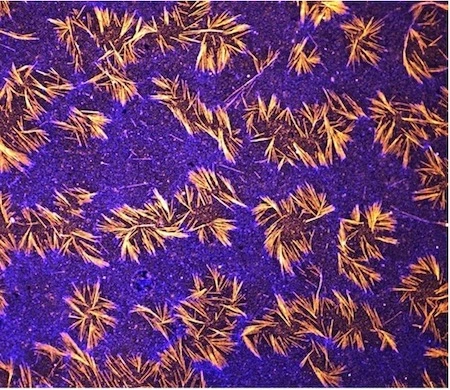
This discovery, resulting from a collaboration among several institutions [1], focuses on the self-organization of microtubules, filaments that are essential for intracellular transport. By recreating an in vitro system with microtubules and molecular motors, the researchers observed the spontaneous formation of regular patterns, alternating between bands and spots. These patterns, although seemingly stable, are constantly evolving under the influence of the active molecular motors.
The process relies on a delicate balance between transport, diffusion, and mechanical forces. If one type of motor dominates in concentration, the patterns do not form. A slight change in concentration can transform chaotic motion into an organized structure.
Unlike Turing patterns, these structures do not arise at the center of the spots but at their periphery, where microtubules separate the motors and create distinct patterns. This research could explain how cells align their microtubules and organize their internal space. This breakthrough could challenge current models explaining the mechanisms that define the axis of cell orientation in space and opens new avenues for understanding the fundamental mechanisms of cell biology.
Notes
[1] L’équipe du CytoMorpho lab (ESPCI Paris – PSL, CEA, CNRS) dirigée par Manuel Théry et Laurent Blanchoin et une équipe du Collège de France et de l’Institut Curie dirigée par Jean-François Joanny.
Image: Microscopy image showing microtubules, NCD, and KIF5B self-organizing into high-density microtubule patterns.
References
C. Utzschneider, B. Suresh, A. Sciortino, J. Gaillard, A. Schaeffer, S. Pattanayak, J. Joanny, L. Blanchoin, M. Théry, Force balance of opposing diffusive motors generates polarity-sorted microtubule patterns, Proc. Natl. Acad. Sci. U.S.A.
121 (49) e2406985121,
https://doi.org/10.1073/pnas.2406985121 (2024).
 Published on 28/11/2024
 Research
 Manuel Théry : manuel.thery@espci.fr