A Ruby-Superconducting hybrid system for quantum information

As part of research into emerging quantum technologies, researchers are exploring alternatives to traditional quantum bits. Among these, “qudits”,systems with multiple quantum levels, offer a wealth of manipulation possibilities that have yet to be tapped. A team [1] from the Laboratory of Physics and Materials Science (LPEM) at ESPCI Paris – PSL has focused on a natural qudit: the chromium ion (Cr³⁺) present in a ruby crystal, whose four spin levels can interact with microwave light in a superconducting cavity. Their study sheds light on the subtleties of this interaction between matter and the electromagnetic field within a miniature quantum device.
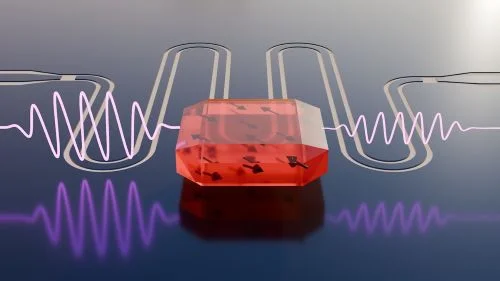
The experimental setup combines a ruby crystal with a resonant cavity made from a high-critical-temperature superconductor. By applying a magnetic field and using the electron spin resonance (ESR) technique, the researchers probe the transitions between the spin levels of chromium. These transitions, analogous to electron jumps between orbitals, are induced by quantum fluctuations in the microwave field within the cavity.
The originality of this approach lies in the ability to control the number and intensity of observable transitions. By tilting the ruby’s crystal axis relative to the magnetic field, the team is able to vary the complexity of the system, from two to four active transitions. Each configuration corresponds to a characteristic ESR spectrum, which reveals how the spins absorb or exchange photons with the cavity.
The measurements, conducted at temperatures ranging from 30 millikelvin to 16 kelvin, show that the strength of spin-photon coupling depends on two competing mechanisms: the thermal distribution of spin populations across energy levels and the quantum selection rules that govern allowed transitions. By combining this experimental investigation with precise electromagnetic simulations, the researchers were able to finely model the system’s dynamics and validate the theoretical framework of the Tavis–Cummings model [2].
Although the strong coupling regime, necessary for direct applications in quantum computing, has not yet been achieved, the study demonstrates the feasibility of precise control over high-spin systems. It paves the way for future quantum information storage or conversion devices utilizing doped crystals, resilient cavities, and microwave manipulation, with the promise of combining fidelity, compactness, and functional diversity.
Notes
[1] Z. Velluire-Pellat, E. Maréchal, C. Feuillet-Palma & N. Bergeal du Laboratoire de Physique et d’Étude des Matériaux (LPEM) de l’ESPCI Paris – PSL ; CNRS ; Sorbonne Université
[2] Ce cadre théorique l’interaction collective entre plusieurs spins quantiques et un champ électromagnétique dans une cavité.
Image: A ruby crystal (in red), containing chromium ions acting as quantum spins, is placed at the center of a superconducting microwave cavity. This setup makes it possible to probe interactions between spins and photons at very low temperatures. Illustration by Zoé Velluire-Pellat, co-author of the study.
References
Velluire-Pellat, Z., Maréchal, E., Feuillet-Palma, C. et al. Spin-photon interaction between a ruby crystal and a high-critical-temperature superconducting microwave cavity. Commun Phys 8, 236 (2025). https://doi.org/10.1038/s42005-025-02159-1
 Published on 03/07/2025
 Research
 Paul Turpault paul.turpault (arobase) espci.fr