A stable mixture of water and oil observed for the first time

Scientists from ESPCI Paris – PSL, the CNRS¹, and the French company Calyxia² observed that a thin layer of oil separating two water droplets could cause an adhesive interaction between them while preventing them from coalescing. This discovery enables the creation of ultra-pure materials without solvents or surfactants, ranging from biodegradable colloidal capsules to a new generation of hybrid materials.
An emulsion is a mixture of two immiscible liquids, such as water and oil. Through agitation, one of the liquids can be dispersed into fine droplets within the other. However, when agitation stops and as time passes, these droplets move closer together and then coalesce to form increasingly larger droplets until the two phases, oil and water, are once again completely separate from one another.
The addition of a third component, an amphiphilic substance, meaning it has an affinity for the water-oil interface, known as a surfactant, prevents the droplets from coalescing. Emulsions, which today rely heavily on the use of surfactants and solvents, are found in a wide variety of industrial sectors (food, cosmetics and healthcare, construction, road building, and metallurgy).
Researchers recently observed a completely counterintuitive phenomenon involving a mixture composed solely of pure water and oil: the spontaneous formation of an ultrathin but unusually stable oil film between water droplets dispersed in various types of oils. This surprising phenomenon causes systematic adhesion between the droplets while preventing their coalescence. It is thus possible to permanently disperse large proportions of water in oil (80% or more). However, this phenomenon is limited to oils with high molecular weights that exhibit a certain alternation of polarity. This excludes, for example, aliphatic hydrocarbons. On the other hand, oils containing alternating oxygen and carbon atoms, such as all vegetable oils, are good candidates.
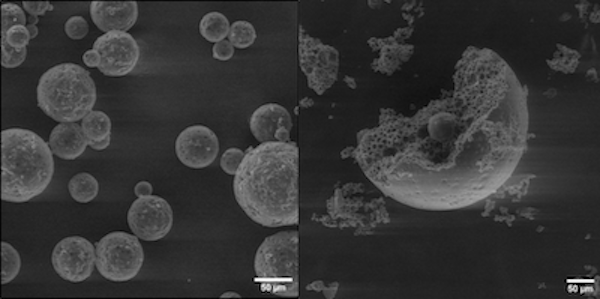
Researchers have demonstrated that these types of oils can change their configuration when confined between two water droplets. In fact, by preferentially orienting their hydrophilic parts toward the water and their hydrophobic parts toward the opposite side, an ultra-thin adhesive film, induced by the affinity of the hydrophobic parts, spontaneously forms as soon as the two interfaces come into contact. The thin film then acquires high viscosity while reducing the free energy at the interface, as evidenced by the adhesion between the droplets. Such a phenomenon of spontaneous gelation between two liquids had never been observed before.
The use of polymerizable vegetable oils, combined with the ability to mix them with water, opens the door to a variety of fully biodegradable polymeric materials. Based on this discovery, researchers have demonstrated the feasibility of manufacturing microcapsules for a wide range of industries where biodegradability is becoming essential. Finally, a new generation of hybrid materials is under study, with precisely controlled mechanical properties and biodegradability for the packaging and construction industries.
Notes
1 du Laboratoire Colloïdes et Matériaux Divisés au sein de l’Institut Chimie Biologie Innovation (CNRS/ ESPCI Paris – PSL)
2 Entreprise spécialisée dans la conception et la fabrication de microcapsules biodégradables et de Harvard université usa.
References
Auteurs de l’étude : Claire Nannette, Jean Baudry, Anqi Chen, Yiqiao Song, Abdulwahed Shglabow, Nicolas Bremond, Damien Démoûlin, Jamie Walters, David A. Weitz, and Jérôme Bibette.
 Published on 15/04/2024
 Research