[1] Travaux menés au sein du Laboratoire Plasticité du Cerveau (ESPCI Paris – PSL, CNRS) en collaboration avec des chercheurs de Sorbonne Université, de l’Inserm et de l’Institut Pasteur.
Alcohol and nicotine: the same brain circuit drives reward and anxiety

By exploring the effects of nicotine and alcohol on the brain, researchers at ESPCI Paris – PSL [1] have revealed the existence of a common neural circuit that closely links reward and anxiety-related behaviors. This discovery highlights a brain mechanism shared by these two substances and sheds light on the neurobiological foundations of their frequent and often combined use.
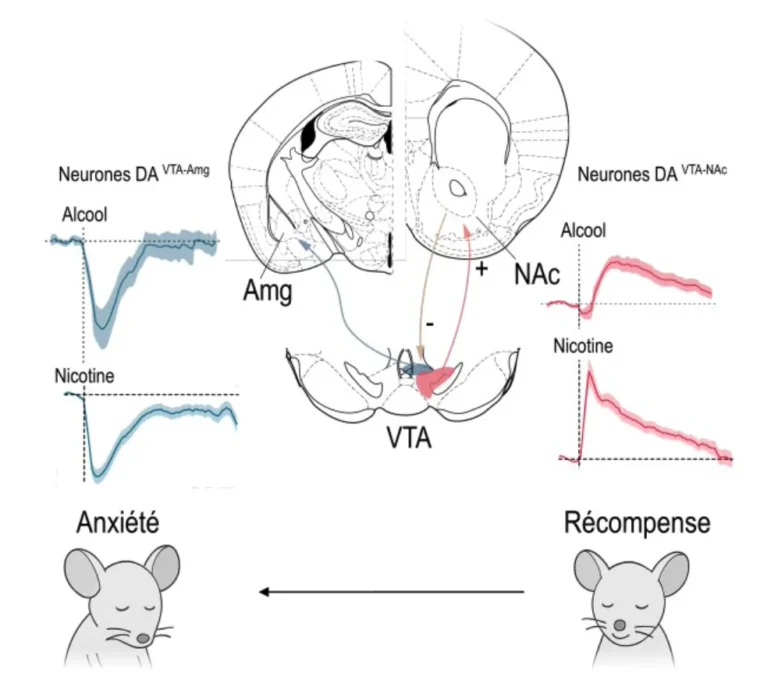
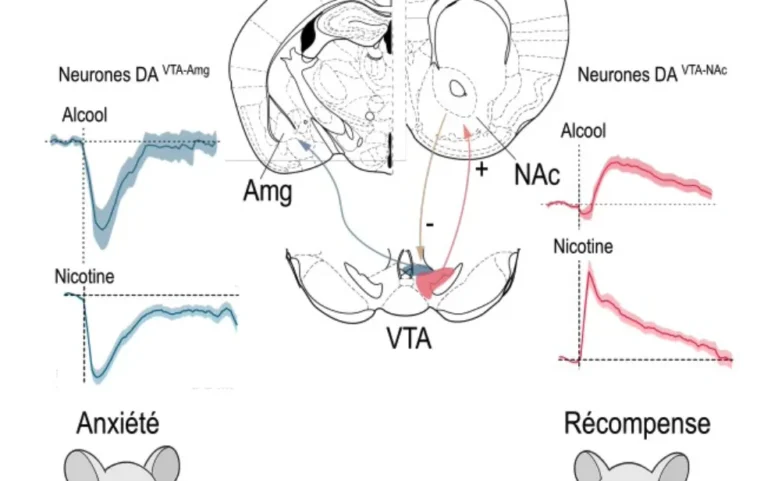
The research focuses on the ventral tegmental area (VTA), a key region of the reward system. Scientists studied two distinct dopaminergic pathways originating in this area: one projecting to the nucleus accumbens (NAc), which is involved in the sensation of reward, and the other to the amygdala, a structure essential for regulating emotions and anxiety.
The results show that nicotine and alcohol activate the dopaminergic pathway leading to the NAc, which produces a positive reinforcing effect. However, this activation is accompanied by indirect inhibition of dopaminergic neurons projecting to the amygdala. This phenomenon is based on a feedback loop: activation of the NAc triggers an inhibitory signal, transmitted by GABAergic neurons, which deactivates the VTA→amygdala neurons. This deactivation promotes the emergence of anxiety-related behaviors.
Both substances follow this same pathway, and their effects are additive. By blocking this loop using optogenetic tools, the researchers were able to reverse the anxiety-inducing effect caused by alcohol and nicotine in mice, confirming the key role of this mechanism.
This research shows that the negative effects of these drugs on mood are not indirect consequences, but rather the direct result of the activation of the dopaminergic reward circuit. This breakthrough provides a better understanding of vulnerability to multiple addictions, particularly the concurrent use of alcohol and tobacco, and opens up new avenues for deciphering the brain’s dynamics between pleasure and distress.
Notes
References
Le Borgne, T., Nguyen, C., Vicq, E. et al. Nicotine engages a VTA-NAc feedback loop to inhibit amygdala-projecting dopamine neurons and induce anxiety-like behaviors. Nat Commun 16, 6196 (2025). https://doi.org/10.1038/s41467-025-61180-8
Key information
 Published on 09/07/2025
 Research
 Paul Turpault paul.turpault@espci.fr