[1] Dont une équipe du Laboratoire Plasticité du cerveau de l’ESPCI Paris – PSL / CNRS / INSERM
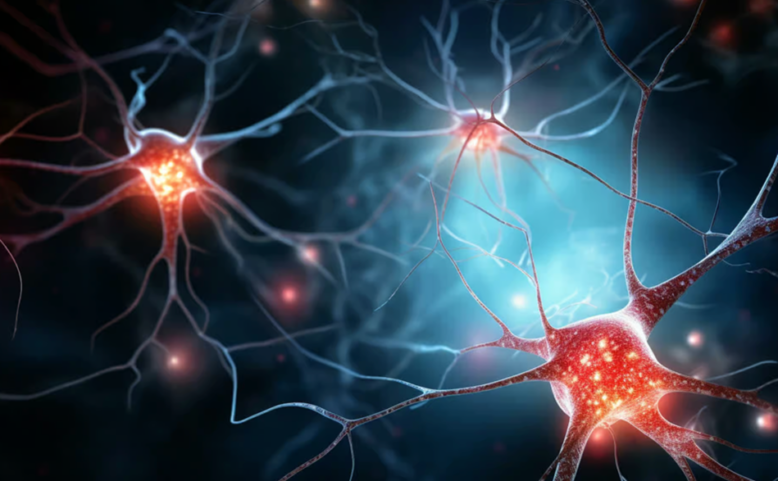
Image: Artist’s rendering of dopaminergic neurons

Dopamine is a molecule released by certain neurons; it strengthens the links between an action and the potential benefit that results from it. But its exact role in motivation remained unclear: how is it that, even after learning that a specific action leads to a reward, we do not always perform that action every time, but only when we are sufficiently motivated?
A recent study published in Nature Communications sheds new light on this issue. The researchers [1] developed the concept of a “latent attractor”, a stable state of neural activity, initially silent, that represents the association between an action and its reward. This attractor, established through dopaminergic signaling during learning, remains potentially available without necessarily manifesting itself. The key to its activation lies in motivation: when the organism is in a favorable context, for example, if it is hungry, an additional release of dopamine activates this latent attractor. It then becomes a true internal guide, directing behavior toward the performance of the corresponding action, such as moving toward food.
To achieve this result, the researchers used approaches that combined optogenetics with the recording of neuronal activity in mice. They specifically stimulated dopaminergic neurons while observing how the animals behaved in an environment containing an area previously associated with a reward. They found that this stimulation triggered an immediate and determined movement in the mice toward that zone, even from a great distance. This response is not simply the result of general motor excitation, but reveals the targeted activation of a latent attractor stored in the neural network.
In short, this study sheds new light on the function of dopamine. It does more than simply signal discrepancies between expected and actual rewards to facilitate learning; it also helps “unlock” associations that have already been established but have remained inactive until now. These “latent attractors” form a sort of neural blueprint ready to be activated as soon as the internal state and the environment are conducive to it. Thus, dopamine facilitates both the formation of links between actions and rewards and the execution of those actions once motivation is present. This breakthrough helps us understand how the brain naturally transitions from mere knowledge to purposeful action.
[1] Dont une équipe du Laboratoire Plasticité du cerveau de l’ESPCI Paris – PSL / CNRS / INSERM
Image: Artist’s rendering of dopaminergic neurons
Naudé, J., Sarazin, M.X.B., Mondoloni, S. et al. Dopamine builds and reveals reward-associated latent behavioral attractors. Nat Commun 15, 9825 (2024). https://doi.org/10.1038/s41467-024-53976-x
 Published on 12/12/2024
 Research
 Paul Turpault, responsable de la communication scientifique de l’ESPCI paul.turpault@espci.fr