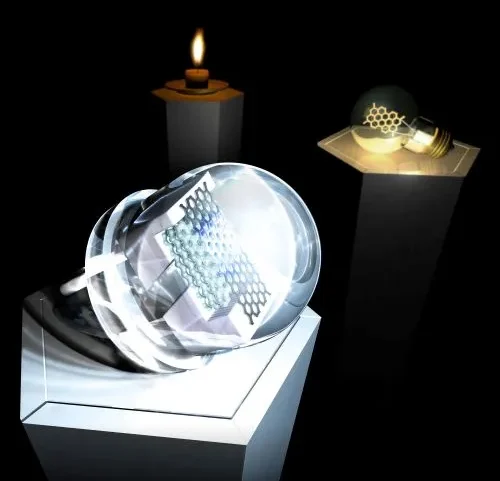
Graphene emits light beyond incandescence: A breakthrough in infrared electroluminescence from 2D Materials

For the first time, French researchers, including a team from the Langevin Institute, have observed a phenomenon previously considered unlikely: electroluminescence in graphene. This ultra-thin material, already renowned for its extraordinary electronic properties, is nevertheless a semimetal with no bandgap, and is therefore, in theory, incapable of emitting light the way a light-emitting diode would. And yet, when subjected to a high electrical voltage, graphene emits light… far beyond its natural incandescence. Published in the journal Nature, this major discovery revolutionizes our understanding of light-matter interactions in two-dimensional materials.
The experiments, conducted at the École Normale Supérieure Physics Laboratory (LPENS), rely on nanoscale devices designed to operate at room temperature. By applying an electric voltage between two metal electrodes deposited on graphene encapsulated in hexagonal boron nitride (hBN), LPENS researchers initially observed anomalies in the electrical transport properties, indirectly indicating a specific phenomenon of electroluminescence.
This initial observation led to a highly stimulating collaboration aimed at directly observing the phenomenon using ultra-sensitive infrared techniques developed at the Langevin Institute. The research demonstrated that the anomalies observed in electrical transport were accompanied by intense infrared emission, clearly distinct from the thermal radiation associated with the dissipation of current as heat.
This emission, studied in detail by a large consortium, results from an interband tunneling mechanism. In short, electrons are injected into graphene with sufficient energy to produce light, without undergoing conventional recombination as in semiconductors. This is highly unexpected behavior for a “bandgap-free” material.
But that’s not all. The study reveals that infrared light emission is associated with an extremely efficient radiative energy transfer between graphene and its immediate environment, hBN. Up to 75% of the injected electrical power is transferred via electromagnetic coupling to this material, which has very distinctive dielectric properties in the infrared. This transfer depends heavily on the crystalline structure of hBN, paving the way for precise control of optical emission through substrate engineering.
Taken together, these results mark a decisive step forward in understanding radiative sources in 2D materials. The collaboration between several French laboratories (LPENS, Institut Langevin, ONERA, LMI at INSA Lyon, and the Charles Fabry Laboratory) has led to experimental proof that it is possible to create graphene-based electroluminescent devices that are compact and potentially tunable over a wide range of infrared wavelengths.
This is a promising prospect, particularly in the fields of sensors, spectroscopy, and infrared optical communications, where compact and efficient light sources remain very limited today. Graphene electroluminescence could therefore well become a key new tool in the arsenal of tomorrow’s photonic technologies.
References
Abou-Hamdan, L., Schmitt, A., Bretel, R. et al. Electroluminescence and energy transfer mediated by hyperbolic polaritons. Nature 639, 909–914 (2025).
https://doi.org/10.1038/s41586-025-08627-6
 Published on 02/04/2025
 Research
 Yannick De Wilde : yannick.dewilde@espci.fr Emmanuel Baudin : emmanuel.baudin@phys.ens.fr