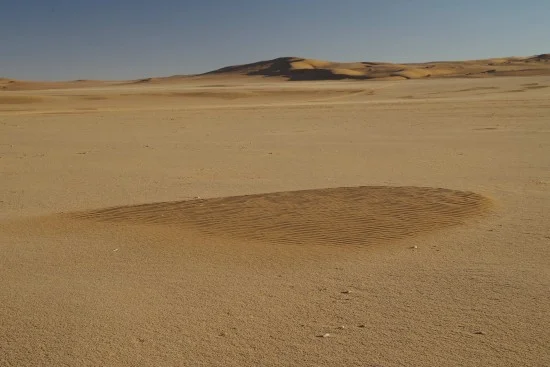
Dune landscapes are not limited to the vast, undulating hills of deserts. Between the main dunes, in areas that are sometimes compact or gravelly, small sandy formations just a few meters in size also appear. Too small to be called dunes, yet too large to be mere ripples, these ephemeral structures raise questions: How do they form, and why do they sometimes persist, even though existing theories predict their rapid disappearance?
A team of researchers [1] has developed a model to understand the dynamics of these medium-sized sand formations, observed in particular in the Namib Desert. There, winds transport sand from one dune to another, passing through an area with a non-erodible substrate. In these areas, patches of sand form, grow, migrate, and sometimes disappear. However, their evolution is inconsistent with the models that explain dune formation.
Researchers have shown that the key to the mystery lies in how the wind’s transport capacity varies depending on the nature of the ground. A given wind transports more sand over a consolidated surface (such as gravel or wet sand) than over loose sandy ground. Furthermore, this capacity does not change instantly from one soil type to another: a spatial transition is required. This transition creates zones of erosion upstream and deposition downstream of the patch, which explain the formation, growth, or disappearance of these small sandy features.
By combining this dual transport law with this new parameter, a characteristic transition length, and applying it to classical dune dynamics models, the authors were able to accurately reproduce the topographic data collected in the field. The model predicts three behavioral regimes, rapid disappearance, growth and migration, or gradual spreading, depending on the incoming sand flux and the integration time.
These findings enhance our understanding of sand transport and dune formation. They also highlight the crucial role of soil heterogeneities in sandy landscapes, which are often overlooked. A better understanding of these ephemeral landforms could, in the long term, help estimate sand flows in arid or coastal areas, and even identify conditions favorable to the formation of new dunes through this novel process.
This research was conducted by scientists at the PMMH laboratory (CNRS / ESPCI Paris – PSL) in collaboration with several international institutions, with field measurements taken in the Namib Desert (Namibia).
Notes
[1] Ce travail a été mené par des chercheurs du laboratoire PMMH (CNRS / ESPCI Paris – PSL) en collaboration avec plusieurs institutions internationales : University of Southampton, Institut de Physique du Globe de Paris (Université Paris Cité), ENS – Laboratoire de Géologie, University of Oxford, Loughborough University, University of Illinois at Urbana-Champaign, et University of Colorado Denver. Les mesures de terrain ont été réalisées dans le désert du Namib (Namibie).
References
C. Rambert, J.M. Nield, C. Narteau, P. Delorme, G.F.S. Wiggs, M.C. Baddock, J. Best, K.T. Christensen, & P. Claudin, Modeling the dynamics of aeolian meter-scale bedforms induced by bed heterogeneities, Proc. Natl. Acad. Sci. U.S.A. 122 (20) e2426143122, https://doi.org/10.1073/pnas.2426143122 (2025).