[1] Chercheurs et institutions impliqués : Jishen Zhang, Alejandro Ibarra, Benoît Roman (PMMH – Physique et mécanique des milieux hétérogènes) & Matteo Ciccotti (SIMM – Sciences et ingénierie de la matière molle). Institutions impliquées : CNRS – Centre national de la recherche scientifique, ESPCI Paris – PSL, Sorbonne Université, Université Paris Cité.
Why does Tête de Moine form flowers?

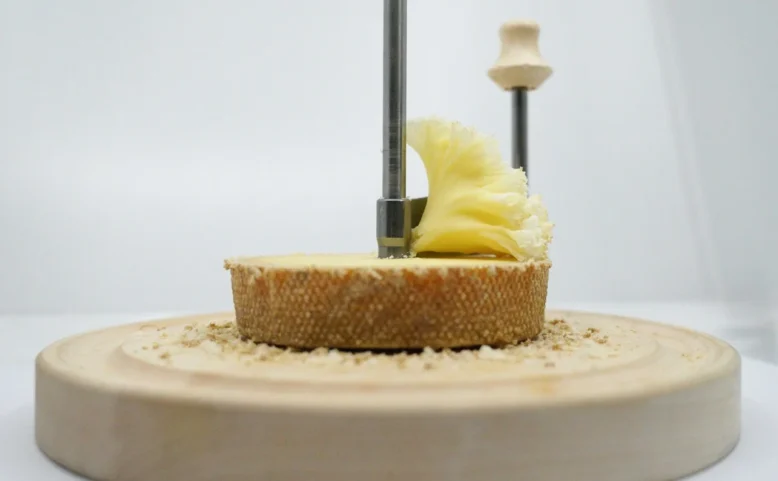
When a wheel of Tête de Moine is shaved with the traditional tool called a Girolle, the cheese transforms into thin, pleated rosettes that resemble flowers. Beyond their aesthetic appeal, these “cheese flowers” offer a unique taste experience thanks to their airy texture. But how can a simple mechanical action produce such a complex shape?
A team of researchers [1] investigated this unique phenomenon. This research is the result of a unique collaboration between two laboratories at ESPCI Paris – PSL: the PMMH Laboratory (Physics and Mechanics of Heterogeneous Media) and the SIMM Laboratory (Science and Engineering of Soft Matter). By closely observing how the cheese is cut, they demonstrated that the deformation of the shavings results from a plastic process: the cheese does not bend elastically like a sheet of paper, but undergoes an irreversible transformation, comparable to that observed when cutting metals.
The key to the formation of the flowers lies in the uneven contraction of the cheese during slicing. By measuring how the shavings contract based on their distance from the center, the researchers found a significant reduction in length in the central area of the cheese, while the periphery remains almost intact. This variation in “metric” creates a geometric frustration that causes the shavings to fold into a three-dimensional shape, like a sheet of paper that is too large for a flat surface.
But where does this difference in contraction come from? The answer is surprising: it depends not so much on the cheese’s mechanical properties (elasticity, strength, etc.) as on the variation in friction between the cheese and the blade. Near the rind, the cheese is drier and slides more easily; toward the center, it is stickier. This friction gradient subtly alters the shear angle during cutting, resulting in greater contraction at the center of the cheese. The result: a shavings with almost flat edges, but whose center folds back and curls, giving rise to the “flower.”
This mechanism of morphogenesis through inhomogeneous plastic shear opens up possibilities far beyond cheese. It could inspire new shaping strategies for flexible or metallic materials, particularly by using friction to induce complex shapes. A simple scraping motion might then be enough to carve intricate patterns into the material.
Notes
References
Morphogenesis of Cheese Flowers through Scraping, J. Zhang, A. Ibarra, B. Roman and M. Ciccotti, Phys. Rev. Lett. 134, 208201 – Published 21 May, 2025
https://doi.org/10.1103/PhysRevLett.134.208201
Key information
 Published on 27/05/2025
 Research
 Paul Turpault paul.turpault@espci.fr