Finding a needle in a haystack? An object hidden in thick fog? Conventional imaging techniques, whether ultrasound, microscopy, or radar, all face the same obstacle: multiple scattering. When a wave propagates through a highly heterogeneous medium, it is scattered numerous times before returning to the detector. The resulting image becomes blurred, to the point of completely obscuring the target being sought.
To overcome this limitation, researchers have developed an innovative approach based on a simple yet effective concept: the matrix fingerprint. Every object has a unique signature, its own distinct way of scattering waves. This signature can be described mathematically by a reflection matrix, which serves as the object’s “fingerprint.” Even when buried in a highly scattering medium, the object retains its fingerprint; it is merely drowned out by ambient scattering noise.
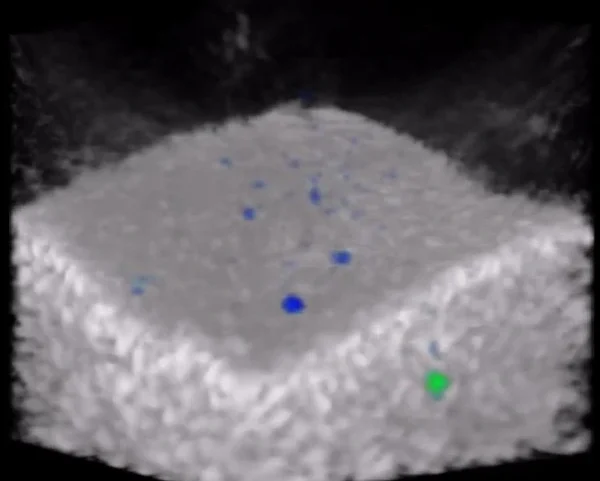
The researchers’ idea [1] is to exploit the correlations between the matrix measured in the fog and the reference pattern. These correlations make it possible to isolate the specific contributions of the target and make them visible with a precision better than the wavelength used. Instead of correcting for the effects of noise, a virtually impossible task in opaque media, the method reveals what in the signal is resistant to interference. To validate this principle, the team conducted several experiments in ultrasonic acoustics. Metal spheres buried in a granular suspension, which are completely invisible using conventional ultrasound, could be located with near-certain reliability. In a second test, the method detected lesion markers used in breast cancer diagnosis, which are often difficult to distinguish amid tissue noise. Finally, when applied in vivo to a human calf, it revealed the architecture of muscle fibers, paving the way for quantitative tissue imaging, which is invaluable for diagnosing cardiac or neuromuscular diseases.
Beyond these proof-of-concept demonstrations, the matrix fingerprint stands out for its flexibility and versatility. Applicable to any type of wave, provided a multi-element sensor is available, it paves the way for a wide range of applications: monitoring medical instruments in interventional radiology, non-destructive testing of materials, improving radar and sonar systems, and even local measurement of physical parameters such as temperature or pressure, which are typically inaccessible from a distance.
By revealing what lies hidden in the fog of electromagnetic waves, this approach offers a truly new way of seeing the invisible, with perspectives that extend far beyond the realm of fundamental physics.
This research was supported by an ERC Consolidator Grant (No. 819261) under the European Union’s Horizon 2020 research and innovation program. This innovation is also the subject of a patent filed by SuperSonic Imagine, jointly owned with the CNRS and ESPCI (French Patent No. 2314789, 2023).
Notes
[1] de l’Institut Langevin (ESPCI Paris – PSL, CNRS) et de l’Université Technique de Vienne (TU Wien)
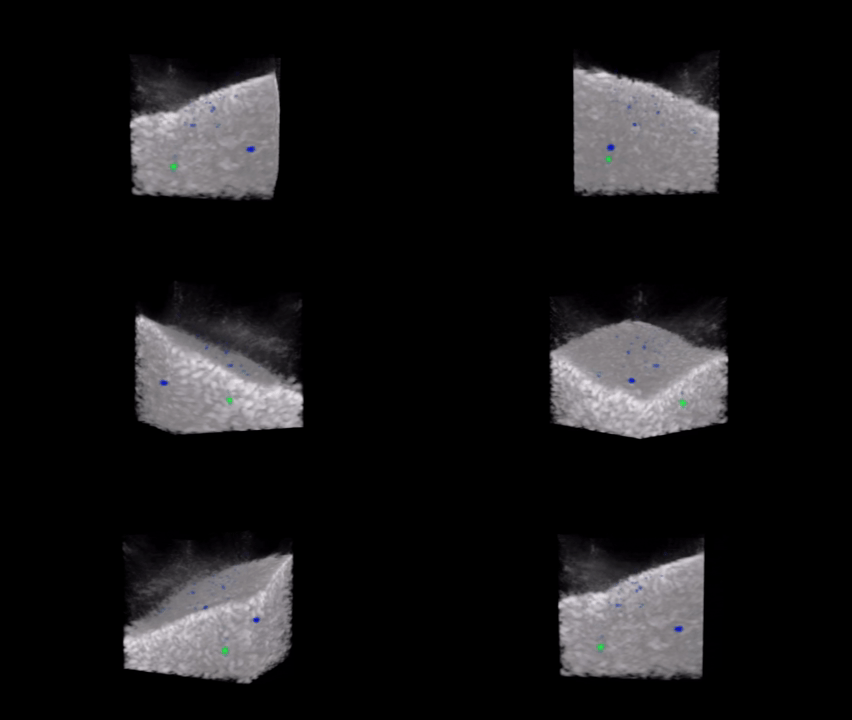
Image: Probability density maps showing the locations of two metal spheres buried in an ultra-diffusive granular suspension, overlaid on a completely scrambled black-and-white ultrasound image. Each color corresponds to a different sphere diameter: 10 mm (blue) and 8 mm (green). Image credit: Arthur Le Ber.
Pour offrir les meilleures expériences, nous utilisons des technologies telles que les cookies pour stocker et/ou accéder aux informations des appareils. Le fait de consentir à ces technologies nous permettra de traiter des données telles que le comportement de navigation ou les ID uniques sur ce site. Le fait de ne pas consentir ou de retirer son consentement peut avoir un effet négatif sur certaines caractéristiques et fonctions.
Fonctionnel
Always active
Le stockage ou l’accès technique est strictement nécessaire dans la finalité d’intérêt légitime de permettre l’utilisation d’un service spécifique explicitement demandé par l’abonné ou l’utilisateur, ou dans le seul but d’effectuer la transmission d’une communication sur un réseau de communications électroniques.
Préférences
Le stockage ou l’accès technique est nécessaire dans la finalité d’intérêt légitime de stocker des préférences qui ne sont pas demandées par l’abonné ou l’utilisateur.
Statistiques
Le stockage ou l’accès technique qui est utilisé exclusivement à des fins statistiques.Le stockage ou l’accès technique qui est utilisé exclusivement dans des finalités statistiques anonymes. En l’absence d’une assignation à comparaître, d’une conformité volontaire de la part de votre fournisseur d’accès à internet ou d’enregistrements supplémentaires provenant d’une tierce partie, les informations stockées ou extraites à cette seule fin ne peuvent généralement pas être utilisées pour vous identifier.
Marketing
Le stockage ou l’accès technique est nécessaire pour créer des profils d’utilisateurs afin d’envoyer des publicités, ou pour suivre l’utilisateur sur un site web ou sur plusieurs sites web ayant des finalités marketing similaires.