The surprising mobility of ions trapped at solid surfaces

Who hasn’t rubbed a balloon against their hair only to see it stick to the wall? This children’s game illustrates triboelectricity, the phenomenon by which simple contact or friction causes a transfer of electric charges between two materials. Although familiar in everyday life, its mechanisms are still poorly understood. And even more surprising: this process isn’t limited to solids. It can also occur when a drop of water slides across a hydrophobic surface, a unique case of “liquid triboelectrification.”
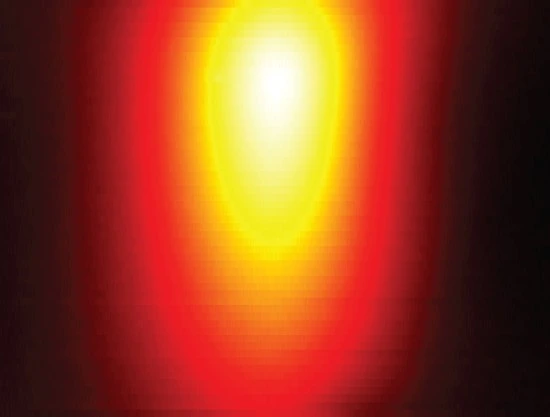
A team of researchers [1] has just shed light on this phenomenon using a novel electrostatic mapping technique capable of tracking, over time and space, the charges left in the wake of a droplet. The result is striking: far from remaining confined to the initial trail, these charges spread rapidly across the entire surface. Their lateral mobility is so high that it even exceeds that of ions in aqueous solution, whereas one would have expected, on the contrary, a slowdown due to contact with the solid.
Simulations conducted in parallel with these experiments show that these charges correspond to hydrated ions trapped at the interface. In other words, each ion remains surrounded by a thin shell of water molecules that partially isolates it from the substrate. In this unique state, dubbed an “ionic puddle,” the ion literally glides across the surface, restricted only by the friction between its hydration layer and the substrate. This interfacial friction, which is much weaker than expected, explains the extraordinarily high diffusion rate measured.
Another surprise: the spread of the charges does not depend on their density. The ions move independently of one another, without repelling each other, a sign that the process is entirely governed by the interaction with the surface. Furthermore, by adjusting the pH of the water, it is possible to change the sign and intensity of the deposited charge, confirming the direct involvement of the ionic species present in the droplet.
These results reveal a new state of matter, known as an “ionic puddle,” in which hydrated ions behave like quasi-free particles despite being trapped at the surface. They shed new light on triboelectrification between solids, the origin of which may lie in the transfer of charged nanometer-scale water films. In the longer term, understanding the dynamics of these “ionic puddles” could inspire advances in nanofluidics, ionic electronics, or, why not? in the design of energy generators based on the movement of droplets.
Notes
[1] Des chercheurs du laboratoire SIMM (Sciences et Ingénierie de la Matière Molle, ESPCI Paris – Université PSL, CNRS), en collaboration avec un collègue du Laboratoire Interdisciplinaire de Physique (Université Grenoble Alpes, CNRS).
References
Z. Benrahla,T. Saide,L. Burnaz,E. Verneuil,S. Gravelle, & J. Comtet, Giant mobility of surface-trapped ionic charges following liquid tribocharging, Proc. Natl. Acad. Sci. U.S.A. 122 (37) e2505841122, https://doi.org/10.1073/pnas.2505841122 (2025).
 Published on 11/09/2025
 Research
 Jean Comtet – Chercheur, co-auteur de l’étude
 Paul Turpault