Underground, Fungi organize large-scale carbon transport

Mycorrhizal fungi build complex underground networks to exchange nutrients with plants and store carbon in the soil. Published in Nature on February 26, 2025, a study conducted by 28 researchers from around the world, including scientists from the Physics and Mechanics of Heterogeneous Media (PMMH) laboratory at ESPCI Paris – PSL, reveals how these networks function as ingenious supply chains, forming the basis of one of the most widespread symbiotic relationships in nature and present in the roots of more than 70% of the plants on Earth.
Mycorrhizal fungi depend on the carbon provided by the plant with which they live in symbiosis. By colonizing a plant’s roots, they obtain the carbon necessary for their development in exchange for nutrients that are crucial for the plant’s growth. This partnership involves managing significant challenges: balancing the costs of building the mycorrhizal network as it grows, while ensuring the efficient transport of resources over long distances to and from the roots.
Using an imaging robot designed by the researchers, the growth of mycorrhizal networks was visualized and quantified for the first time. This tool made it possible to simultaneously track more than 500,000 fungal nodes, points where mycelial filaments intersect and interact, and to analyze approximately 100,000 cytoplasmic flow trajectories, revealing the internal movements of nutrients and carbon within the network.
Unlike many biological organisms, whose growth remains exponential as long as resources are available, the mycorrhizal fungi studied curiously adopt a different strategy: they regulate their own growth. After a propagation front has passed, the mycorrhizal network formed by the cell reaches a saturation point at a density that is independent of available resources. For the fungus, this saturation means redirecting the carbon resources obtained from the plant toward exploring new areas. Thus, rather than maximizing their growth, these fungi optimize their spatial extent and, in the long term, their capacity to exchange and capture carbon.
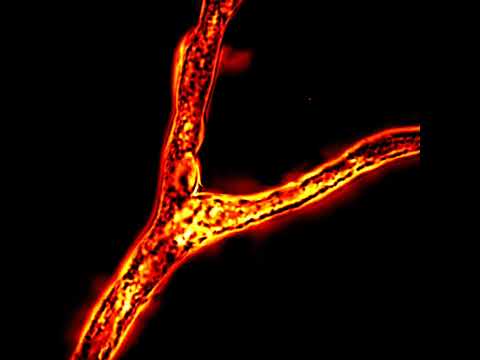
Furthermore, the study measured the growth rate of the mycorrhizal network, which was found to remain constant over time. This underscores the fungus’s need to ensure efficient transport of resources within the network. By measuring cytoplasmic flows within mycorrhizal fungi, the researchers demonstrated the continuous presence of bidirectional transport to and from the roots, evidence of symbiotic exchanges between the plant and the mycorrhizal fungus. The organization of these flows is based on principles comparable to those of a sophisticated and highly efficient logistics chain, shaped by hundreds of millions of years of natural selection.
These networks play a crucial role as entry points for carbon into the world’s soils, absorbing approximately 13 billion metric tons of CO₂ each year, the equivalent of one-third of global energy-related emissions. Despite their importance, the complexity and extent of these networks have been poorly understood until now. This study provides a detailed insight into how mycorrhizal fungi build and optimize their networks to ensure efficient nutrient exchange, thereby influencing ecosystem functioning and carbon cycles.
The discovery of these underground engineering mechanisms sheds new light on the complexity and ingenuity of the interactions that shape ecosystems. Understanding how these fungal networks organize themselves, evolve, and optimize the exchange of resources allows us to explore in greater depth the incredible intelligence of living organisms and the fundamental role of invisible organisms in shaping the world around us. This research also offers new perspectives for better understanding carbon dynamics in soils, a key issue in the face of current environmental upheavals. By revealing these natural strategies for carbon transport and storage, they open up avenues for reflection on how we might, in the future, better incorporate these underground networks into soil and ecosystem management.
Collaboration: The work was conducted in collaboration with numerous research institutions, notably the teams led by Toby Kiers and Tom Shimizu (VU & AMOLF, Amsterdam, NL) and that of Howard Stone (Princeton University, NJ, USA).
Photo and video credits: Loreto Oyarte Galvez (AMOLF & VU, Amsterdam)
References
Oyarte Galvez, L., Bisot, C., Bourrianne, P. et al. A travelling-wave strategy for plant–fungal trade. Nature 639, 172–180 (2025). https://doi.org/10.1038/s41586-025-08614-x
Article du NY Times : https://www.nytimes.com/2025/03/01/science/climate-mycorrhizal-fungus-networks.html
 Published on 20/03/2025
 Research
 Philippe Bourrianne (PMMH, ESPCI Paris) : philippe.bourrianne@espci.fr