Beneath the rubber's surface, wear occurs at the molecular level

Every year, tire wear generates millions of metric tons of particles. Most of these particles are invisible to the naked eye; they are released into the environment and represent a major industrial challenge. Gaining a better understanding of how an elastomer wears down is therefore not just a matter of material performance—it is also a societal issue.
How does an elastomer deteriorate when it rubs against something? The answer is less obvious than it seems, because the initial damage occurs on a microscopic scale and in an area that is difficult to observe. In this study published in *Science Advances*, the researchers show that, during so-called “gentle” wear, the material does not initially degrade through crack propagation. Instead, it accumulates a multitude of diffuse damages beneath the surface, much like a fabric that weakens thread by thread before it frays.
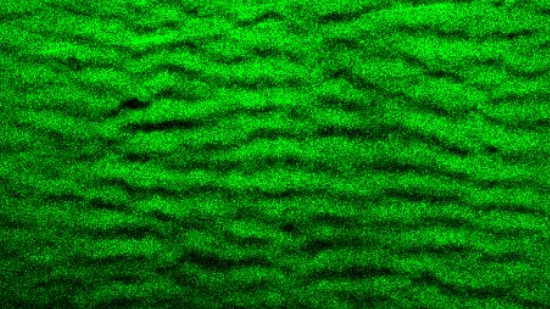
To monitor this incipient wear, the team developed model elastomers containing molecules capable of locally signaling the breakage of polymer chains. A rough glass contact is then repeatedly rubbed against the material, while the friction force and the topography of the worn area are measured. Using three-dimensional mapping with confocal microscopy, the authors visualized for the first time the extent of molecular damage beneath the surface. This damage extends several micrometers deep, well beyond the visible area of abrasion.
The key finding is that this damage occurs in bursts, during micro-slips at the points where surface irregularities come into contact. Its extent therefore depends directly on the size of these surface irregularities. Most importantly, the accumulation of this damage is not linear: it increases slowly over the course of friction cycles. The authors interpret this as a probabilistic process: the most highly stressed polymer chains break first, while subsequent chains require greater stress to break.
The study also reveals a significant trade-off. A molecular architecture that improves resistance to sudden failure does not necessarily protect against repeated wear. Resisting a large crack is therefore not always enough to limit a multitude of small damages. This finding opens up new avenues for designing more durable elastomers, particularly for applications where wear and tear carries a high industrial and environmental cost, such as tires.
Notes
This research was conducted at the Soft Matter Science and Engineering Laboratory (SIMM) at ESPCI Paris – PSL and CNRS, in collaboration with Michelin.
References
Ombeline Taisne et al., “Wear in multiple-network elastomers arises from the continuous accumulation of molecular damage rather than microcrack growth,” Science Advances, 12, eaeb9858 (2026).
DOI: 10.1126/sciadv.aeb9858
 Published on 04/05/2026
 Research
 Jean Comtet – Researcher and co-author of the study
 Paul Turpault – Presse de l’ESPCI Paris - PSL : paul.turpault@espci.fr